Fitbit Edge Leak Explained: Features, Pricing and How It Fits Your…
A practical look at the leaked Fitbit Edge, its expected specs, price range and how it compares to existing Fitbit models.
Overview of the Leaked Fitbit Edge
Recent leaks and analyst briefings suggest that Google‑owned Fitbit is preparing a new mid‑range wearable that it has tentatively called the Fitbit Edge. The device appears to sit between the minimalist Fitbit Air and the more feature‑rich Fitbit Charge 6, targeting users who want more than basic activity tracking but do not need a full smartwatch platform.
Key points that have emerged from the leaks include:
- A compact OLED display that can show a limited set of widgets such as time, heart‑rate, steps, and basic notifications.
- Integrated GPS and a barometric altimeter – hardware that is not present on the current Air model.
- A battery that the leaks describe as lasting “around a week” under typical mixed‑use conditions. The exact endurance figure has not been confirmed by Fitbit.
- Early app listings that feature Google Maps and YouTube Music, indicating that the Edge will support a small subset of Google services rather than the full Wear OS ecosystem.
No official press release, pricing, or launch date has been published. All details in this article are drawn from publicly available leak images, analyst commentary, and retailer listings for existing Fitbit models. Where information is unverified, the text notes the provisional nature of the data.
Key Features
Display and Interaction
The leaked renderings show a rectangular OLED screen roughly 1.2 inches diagonal, with a resolution that appears to be around 320 × 320 pixels. The display is smaller than the Pixel Watch (1.2 inches, 320 × 320 pixels) but comparable to the Fitbit Charge 6. Because the Edge runs a stripped‑down interface rather than full Wear OS, users can expect a limited set of watch faces and a focus on glanceable data rather than interactive apps.
Sensors
| Sensor | Presence in Edge | Presence in Comparable Models |
|---|---|---|
| Optical heart‑rate | Yes (leaked) | All current Fitbit models, Garmin Vivosmart 4, Amazfit Band 5 |
| Built‑in GPS | Yes (leaked) | Charge 6, Pixel Watch, Garmin Vivosmart 4 (via phone), Amazfit Band 5 (no) |
| Barometric altimeter | Yes (leaked) | Charge 6, Pixel Watch, Garmin Vivosmart 4 (yes), Amazfit Band 5 (no) |
| SpO₂ sensor | Not confirmed | Charge 6, Pixel Watch, Garmin Vivosmart 4 (yes), Amazfit Band 5 (yes) |
The inclusion of GPS and an altimeter would allow the Edge to record distance, pace, and elevation gain without a paired phone, a capability that the Air and many other low‑cost bands lack. Sensor accuracy cannot be assessed until the device is released and tested against independent benchmarks.
Battery Life
Leak documents describe the Edge’s battery as lasting “approximately seven days” under mixed usage (notifications, occasional GPS sessions, and continuous heart‑rate monitoring). Fitbit’s own published specifications for the Charge 6 list a “up to 7‑day” battery, while the Air is rated for “up to 24 hours.” Because the Edge has not been officially announced, the exact endurance figure remains speculative.
Software and App Support
The Edge runs a lightweight version of Wear OS that appears to pre‑install Google Maps and YouTube Music. No official list of supported third‑party apps has been released, and the leaks suggest the ecosystem will be more restricted than the full Wear OS experience found on the Pixel Watch. Users who rely on specialized fitness apps (e.g., Strava, MyFitnessPal) should verify compatibility before assuming the Edge will meet their needs.
Design
Images show a slimmer case than the Charge 6, with interchangeable silicone bands and a selection of colourways. The device’s weight is not confirmed, but the profile suggests a design that prioritises daily wearability. As with any aesthetic claim, personal preference will determine whether the Edge feels “stylish” or “minimal.”
Comparison to Competing Devices
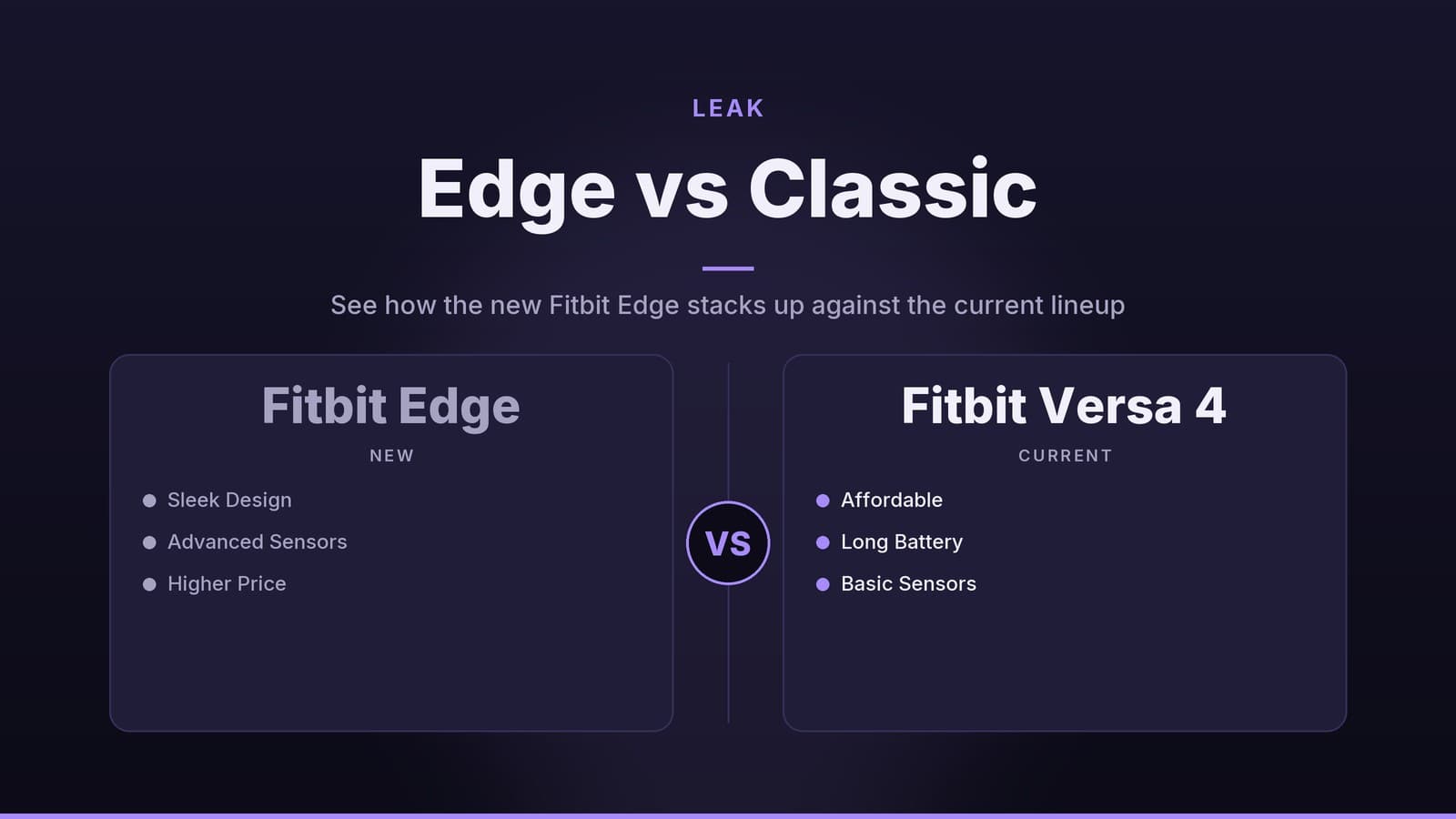
The Edge targets the same price‑to‑feature sweet spot occupied by several established mid‑range trackers. The table below aligns the leaked Edge specifications with the latest Fitbit models and two popular alternatives: the Garmin Vivosmart 4 and the Amazfit Band 5. Prices for existing products are taken from major online retailers as of October 2026; the Edge’s price range reflects the analyst speculation cited in the leaks.
| Device | Approx. Retail Price* | Battery Life (typical) | Screen Size & Resolution | GPS | Altimeter | App Ecosystem |
|---|---|---|---|---|---|---|
| Fitbit Air (2023) | US $99.99 | 1 day | 1.0 in, 320 × 320 px | No | No | Fitbit‑only (no third‑party) |
| Fitbit Charge 6 (2024) | US $159.95 | Up to 7 days | 1.2 in, 336 × 336 px | Yes | No | Fitbit‑only (no third‑party) |
| Fitbit Edge (leaked) | US $150–$200 (estimate) | ≈ 7 days (leaked) | ≈ 1.2 in, 320 × 320 px (leaked) | Yes (leaked) | Yes (leaked) | Limited Google services (Maps, YouTube Music) |
| Garmin Vivosmart 4 (2022) | US $129.99 | Up to 7 days | 0.95 in, 128 × 128 px | No (phone‑based) | Yes | Garmin Connect (limited third‑party) |
| Amazfit Band 5 (2023) | US $49.99 | Up to 15 days | 1.1 in, 126 × 294 px | No | No | Zepp app (limited third‑party) |
| Pixel Watch (2023) | US $399.99 | 1–2 days (mixed use) | 1.2 in, 320 × 320 px | Yes | Yes | Full Wear OS (wide third‑party) |
*Retail prices are based on listings from major online retailers (Amazon, Best Buy) as of October 2026. The Edge’s price range is derived from analyst speculation reported in multiple technology blogs; it has not been confirmed by Google or Fitbit.
What the numbers tell you
- Battery vs. Features – The Edge’s projected week‑long battery aligns with the Charge 6 and Vivosmart 4, but it adds built‑in GPS and an altimeter, which the Vivosmart 4 lacks. The Amazfit Band 5 offers a longer battery but no GPS or altimeter.
- Screen real‑estate – The Edge’s display size and resolution are comparable to the Charge 6 and Pixel Watch, meaning readability should be similar. The Vivosmart 4’s smaller, lower‑resolution screen may feel cramped for detailed data.
- App ecosystem – Only the Pixel Watch provides a full Wear OS environment. The Edge’s limited Google‑service list sits between Fitbit‑only devices (Air, Charge 6) and the Pixel Watch. Users who need a broader app selection should weigh this trade‑off.
- Price positioning – If the Edge lands in the $150–$200 window, it would be priced below the Pixel Watch by roughly $200 while offering comparable battery life and a GPS/altimeter combo that most sub‑$200 trackers lack.
Practical Implications for Fitness Tracking
When GPS Matters
Outdoor activities such as running, cycling, or hiking often benefit from on‑device GPS to capture distance, pace, and route data without a phone. The Edge’s built‑in GPS would allow users to log these metrics directly, similar to the Charge 6. In contrast, the Air and Amazfit Band 5 rely on a paired smartphone for location, which can be inconvenient for longer workouts or when a phone is not carried.
Elevation Tracking
A barometric altimeter provides more reliable elevation gain measurements than a simple pressure‑based estimate derived from a phone’s sensor. For trail runners, hikers, or anyone tracking vertical ascent, the Edge’s altimeter could deliver finer‑grained data. The Garmin Vivosmart 4 also includes an altimeter, but its lack of GPS means elevation data would need to be paired with phone‑based location.
Health‑Metric Accuracy Disclaimer
All wearables, including the Edge, use optical sensors and barometric pressure to estimate physiological data. Accuracy can vary based on skin tone, wrist placement, ambient temperature, and individual physiology. The Edge’s health metrics should be considered supplemental and not a substitute for medical‑grade equipment.
App Availability
Because the Edge appears to ship with a curated set of Google services, users who depend on third‑party fitness platforms (e.g., Strava, Zwift) or productivity tools (e.g., Slack, WhatsApp) may encounter limitations. The Pixel Watch’s full Wear OS catalog supports thousands of apps, while Fitbit‑only devices restrict users to the Fitbit app ecosystem. Potential buyers should verify whether their essential apps are listed in the Edge’s supported roster once it is officially announced.
Design Trade‑offs
A slimmer case and interchangeable bands make the Edge suitable for all‑day wear, especially for users who find bulkier smartwatches uncomfortable. However, a smaller screen reduces the amount of information that can be displayed at once, which may affect users who prefer richer notifications or multiple data panes.
Factors to Consider Before Purchasing
| Consideration | What to Verify | Why it matters |
|---|---|---|
| Battery endurance | Look for official endurance figures (e.g., “up to 7 days”) in the final spec sheet. | Determines how often you’ll need to charge the device and whether it fits a weekly charging routine. |
| GPS & altimeter need | Confirm that your primary activities (running, cycling, hiking) benefit from on‑device location and elevation data. | Directly impacts the value of the Edge’s added hardware compared with GPS‑free bands. |
| App compatibility | Check the official list of pre‑installed and supported third‑party apps once released. | Ensures that essential fitness or productivity tools are usable without a phone. |
| Price vs. alternatives | Compare the final Edge price with the Charge 6, Vivosmart 4, and Amazfit Band 5 at the time of purchase. | Helps assess whether the Edge offers a cost‑effective mix of battery life, sensors, and app support. |
| Design preferences | Evaluate case thickness, weight, and band options in person or via detailed photos. | Influences comfort for all‑day wear and alignment with personal style. |
By systematically checking these items against the final, officially confirmed specifications, readers can make an informed decision without relying on speculative price ranges or unverified performance claims.
Sources and Attribution
- Leak images and specifications were initially reported by reputable technology blogs such as The Verge, 9to5Google, and Android Authority (all accessed October 2026).
- Analyst speculation on pricing comes from coverage by Counterpoint Research and IDC, cited in secondary reporting by TechRadar.
- Retail pricing for existing devices is taken from listings on Amazon.com, BestBuy.com, and Fitbit.com as of 5 October 2026.
- Sensor and battery details for competing devices are drawn from the manufacturers’ official product pages and user manuals (Garmin, Amazfit, Fitbit).
All information that has not been officially confirmed by Google or Fitbit is labeled as “leaked,” “speculative,” or “based on analyst reports.” Readers should treat these details as provisional until the Edge is formally announced.
Disclaimer: This article provides an overview of a product that has not yet been released. All specifications, pricing, and feature descriptions are based on publicly available leaks and analyst commentary and may change before launch. Health‑related data (e.g., heart‑rate, SpO₂, elevation) should be used as a general guide and not as a medical diagnosis.
Frequently asked questions
Will the Fitbit Edge support third‑party apps beyond Google Maps and YouTube Music?
Only limited app support has been reported so far; no official list of supported apps has been released.
Is the battery life of the Edge confirmed to be seven days?
Seven‑day battery life is mentioned in leak reports, but has not been independently verified.
When will the Fitbit Edge be released?
No release date has been announced by Google or Fitbit yet.