Café Pricing Strategy: How to Set Menu Prices That Profit
Learn how to calculate food costs, apply markup, and adjust your café menu prices to ensure profitability without losing customers.
Understand Your True Cost Per Item
Many café owners price their menu based only on the cost of ingredients. If you look only at the price of milk and coffee beans, it can look like you are making a healthy profit. However, this number ignores the barista’s wages, the electricity for the espresso machine, the rent for your space, and the cups and lids that get thrown away. These are your overheads. If you do not account for them, you might be working for free.
To get a realistic picture, you need to calculate your total cost per item. This includes direct ingredients (Cost of Goods Sold, or COGS) and a portion of your fixed costs. A simple way to start is by tracking your Food Cost Percentage. The formula is:
(Cost of Goods Sold / Revenue) x 100
This percentage shows how much of every dollar in sales is spent on ingredients. While specific targets vary by region, supplier contracts, and menu mix, keeping this ratio in check helps ensure you leave room for labor, rent, and other operating expenses. Note: There is no single "correct" percentage for every business. Your ideal ratio depends on your specific location, menu mix, and local labor costs. Check industry resources for your specific region or consult with an accountant to set a target that works for your model.
Calculating Direct Costs
Let’s look at a concrete example for a latte. You should track the following direct inputs:
- Milk: Track the exact volume used per cup and the cost per liter from your supplier.
- Espresso: Track the cost of coffee beans and the yield per shot.
- Cup, lid, and sleeve: Include the cost of disposable packaging.
- Total Direct Cost: Sum these individual line items.
If you sell the latte, your direct margin is the sale price minus this total direct cost. However, you must still cover your barista’s hourly wage and your share of rent. To understand your true profitability, you must look at the item-level food cost. This is calculated by dividing your total direct ingredient cost by the sale price. This figure is different from your overall COGS percentage, which includes all ingredients for all items sold. Accurate tracking of both figures is essential to know if your prices actually cover your fixed overheads.
Allocating Fixed Overheads
Consistency is key to controlling these costs. If one barista pours a different amount of milk than another, your costs fluctuate daily. For small cafés, simple measuring jugs or standardized recipe cards are often sufficient and low-cost. Larger locations may benefit from automated dosing systems, but these require a higher initial investment and maintenance. Choose the method that fits your volume and budget.
You must also track waste. If you throw away expired milk or spill coffee, that cost is real. If you do not track it, you won’t know your true bottom line. Regularly log discarded inventory to identify patterns. Are you over-prepping? Is equipment malfunctioning? Addressing these inefficiencies can improve your margins without changing prices.
Choose Your Pricing Method
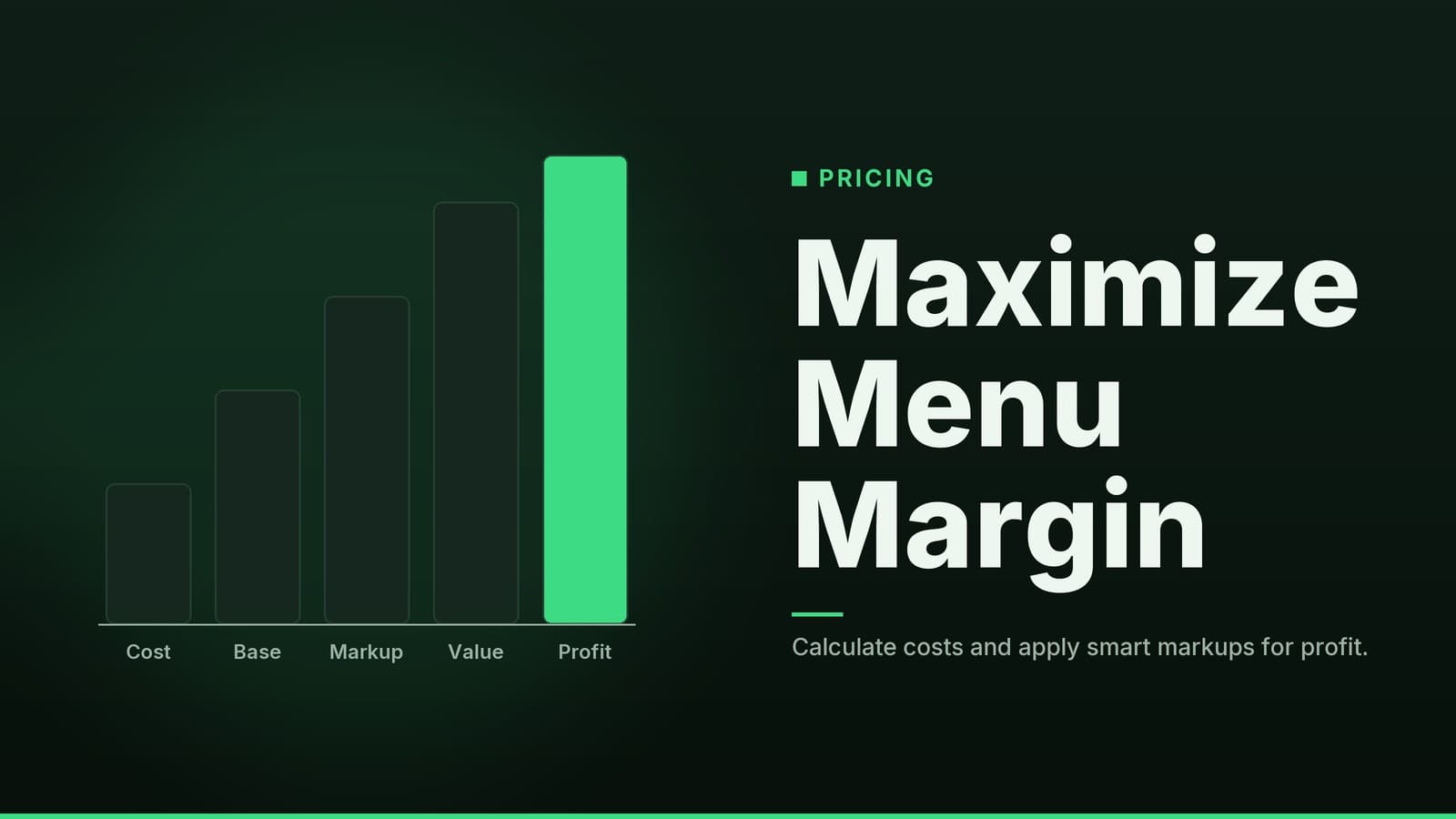
Once you know your true cost, you need to decide how much to charge. There are two main approaches: cost-plus pricing and value-based pricing.
Cost-Plus Pricing
Cost-plus pricing is straightforward. You take your total cost and add a fixed percentage or multiplier. For example, you might use a "rule of three" (multiplying cost by 3) as a starting point. However, in the café industry, this is often too low to cover full overheads. Many owners use a markup of 3x to 4x on ingredient costs as a starting point, not a final rule. You then need to check if that resulting price covers your labor and rent when averaged across all items.
This method is easy to calculate but does not account for what customers are willing to pay. It ensures you cover costs but may leave money on the table if your brand commands a premium.
Value-Based Pricing
Value-based pricing looks at what the customer is willing to pay based on perceived value. This is where your ambiance, brand, and service come in. A latte in a quiet, cozy corner shop with locally roasted beans might command a higher price than the same drink in a high-traffic, no-frills kiosk.
In this model, you are not just selling coffee; you are selling an experience. Customers may pay more for:
- Locally sourced or organic ingredients.
- A comfortable seating area with good Wi-Fi.
- Fast, friendly service during a busy commute.
- A strong brand reputation.
When choosing between these methods, ask yourself:
- What is my break-even point? (The price at which I make zero profit.)
- What do competitors charge? (Not to copy them, but to understand the market ceiling.)
- What value am I providing? (Are we using organic milk? Is our music curated? Do we offer fast, friendly service?)
A common trap is underpricing to compete. If you drop your prices to match a chain next door, you signal that your product is "lower quality" and you erode your margins until you can no longer pay your staff or rent. Price for your value, not just your costs. If your café offers a premium experience, price accordingly. If you are a budget option, focus on speed and volume, but still ensure you cover your fixed costs.
Analyze Your Menu for Profitability
Not all items on your menu are created equal. Some are profit drivers; others are money leaks. Menu engineering is a technique that categorizes your items into four groups based on popularity (sales volume) and profitability (margin).
| Category | Popularity (Units Sold) | Profitability (Gross Margin %) | Strategy |
|---|---|---|---|
| Stars | High | High | Promote these. They are your cash cows. Keep them visible and ensure they are always available. |
| Plowhorses | High | Low | Popular but low margin. Consider raising the price slightly, reducing portions, or reformulating to use cheaper ingredients without changing the taste. |
| Puzzles | Low | High | High margin but few sales. Market these more aggressively. Highlight them on the menu or offer them as add-ons. |
| Dogs | Low | Low | Low sales, low margin. These waste space and attention. Consider removing them or redesigning them. |
To identify these, you need sales data. Most point-of-sale (POS) systems can report which items sell most frequently and what their gross profit is. Look for items that drive the most revenue versus those that drive the most profit. A high-revenue item might have a thin margin, while a lower-revenue item might be highly profitable.
Quarterly Menu Review Checklist
Use this checklist to keep your menu efficient:
- Identify the top 10 best-selling items and verify their profit margins.
- Identify the bottom 10 selling items and determine if the issue is price, name, or placement.
- Remove any "Dogs" that have had no sales for six months or longer.
- Review "Plowhorses" to see if you can increase their price or reduce their cost.
- Highlight "Stars" on your digital menu board or physical menu.
If you find that your "Puzzles" (high profit, low sales) are being ignored, try bundling them. For example, if a high-margin pastry is a Puzzle, pair it with a coffee for a slight discount. This encourages customers to try the item without feeling like they are paying a premium. You can also use email marketing to highlight these items. Our guide on AI Email Marketing Tips for Cafés and Restaurants has ideas on how to segment your customer list to promote specific menu items effectively.
Test and Adjust Your Prices
Pricing is not a one-time event. It is an ongoing process of testing and adjusting. When you decide to increase prices, do it gradually. Large jumps can cause customer backlash and lead to churn. Small, incremental increases are less noticeable and easier for customers to accept.
How to test price sensitivity:
- Pick 2-3 items: Choose items that are stable in demand (not seasonal).
- Increase price slightly: Raise the price of one item by a small percentage (e.g., 5-10%) and leave another unchanged as a control.
- Monitor for several weeks: Track sales volume and total revenue.
- If sales drop slightly but revenue stays the same or increases, the price increase was successful.
- If sales drop significantly and revenue falls, the price increase was too high. Revert or adjust.
Note: The optimal testing period and percentage increase vary by business type and customer base. Start with small changes and monitor results closely before making further adjustments.
Psychological Pricing Tactics
You can also use psychological pricing tactics to influence how customers perceive value. Here is how they compare in a café context:
| Tactic | Description | Best For |
|---|---|---|
| Charm Pricing | Ending a price in .95 or .99 often feels cheaper than a round number. | High-volume, price-sensitive customers. |
| Anchoring | Place a high-priced item near a mid-priced item to make the mid-priced option seem like a better deal. | Menus with a range of price points. |
| Bundling | Offer a "Morning Bundle" (coffee + pastry) at a price slightly lower than the sum of the two items. | Increasing average transaction size. |
Note: The effectiveness of these tactics varies by customer segment and location. There is no one-size-fits-all approach.
Monitoring Feedback
After any price change, listen to your customers. Watch for comments on social media or in-person feedback. If customers start complaining about prices, investigate whether they are comparing you to a cheaper competitor or if they feel the value has dropped. Ensure your service and quality remain high even as prices rise. If you raise prices, you must maintain or improve the experience.
Finally, keep an eye on your overall sales trends. If your average ticket size is increasing but your total number of transactions is dropping, you may be pricing out your core customer base. Balance is key. You want to attract customers who value your product enough to pay a fair price, not just those who are looking for the cheapest option.
Summary and Next Steps
Pricing is a critical part of your business strategy. To get started:
- Calculate your true cost per item by tracking direct ingredients and allocating fixed overheads.
- Choose a pricing method that aligns with your brand value and market position.
- Analyze your menu using menu engineering to identify profit drivers and money leaks.
- Test and adjust your prices regularly based on sales data and customer feedback.
Regularly revisiting your costs and prices ensures your café remains profitable as ingredient costs and wages fluctuate. It’s a small amount of work that can have a significant impact on your bottom line.
Disclaimer: This article provides general business guidance and is not financial or legal advice. Pricing decisions can have complex implications, including regulatory compliance and market dynamics. Consult with a financial advisor or legal professional for advice specific to your business.
Frequently asked questions
What is a good food cost percentage for a café?
While it varies by location and concept, many cafés aim for a food cost percentage between 25% and 35%. This leaves room for labor, rent, and profit. Always verify this against your specific overheads.
How often should I review my menu prices?
Review prices at least quarterly to account for ingredient cost fluctuations. Also review after any significant change in your menu, such as introducing new items or changing suppliers.
Should I price my coffee higher than my food?
Coffee often has a higher margin than food items, so it can be priced to reflect its role as a high-profit driver. However, ensure the overall menu balance supports your total profit goals.