Google AI Weather Model Improves
Google's AI weather model shows measurable skill gain in temperature forecasts, but users should wait for peer-reviewed evaluations.
Core Improvement Summary
Recommendation: If a user’s operational requirement includes a measurable skill gain in root‑mean‑square error (RMSE) for temperature forecasts at 48 h, and the workflow can accommodate a cloud‑based beta API, a short‑term pilot of Google’s AI Weather model is advisable. For users who cannot achieve such a gain, lack the ability to run a pilot, or need proven performance on regulatory‑grade forecasts, continuing with established numerical weather prediction (NWP) services is prudent until independent, peer‑reviewed evaluations become available.
Technical Architecture & Data Inputs
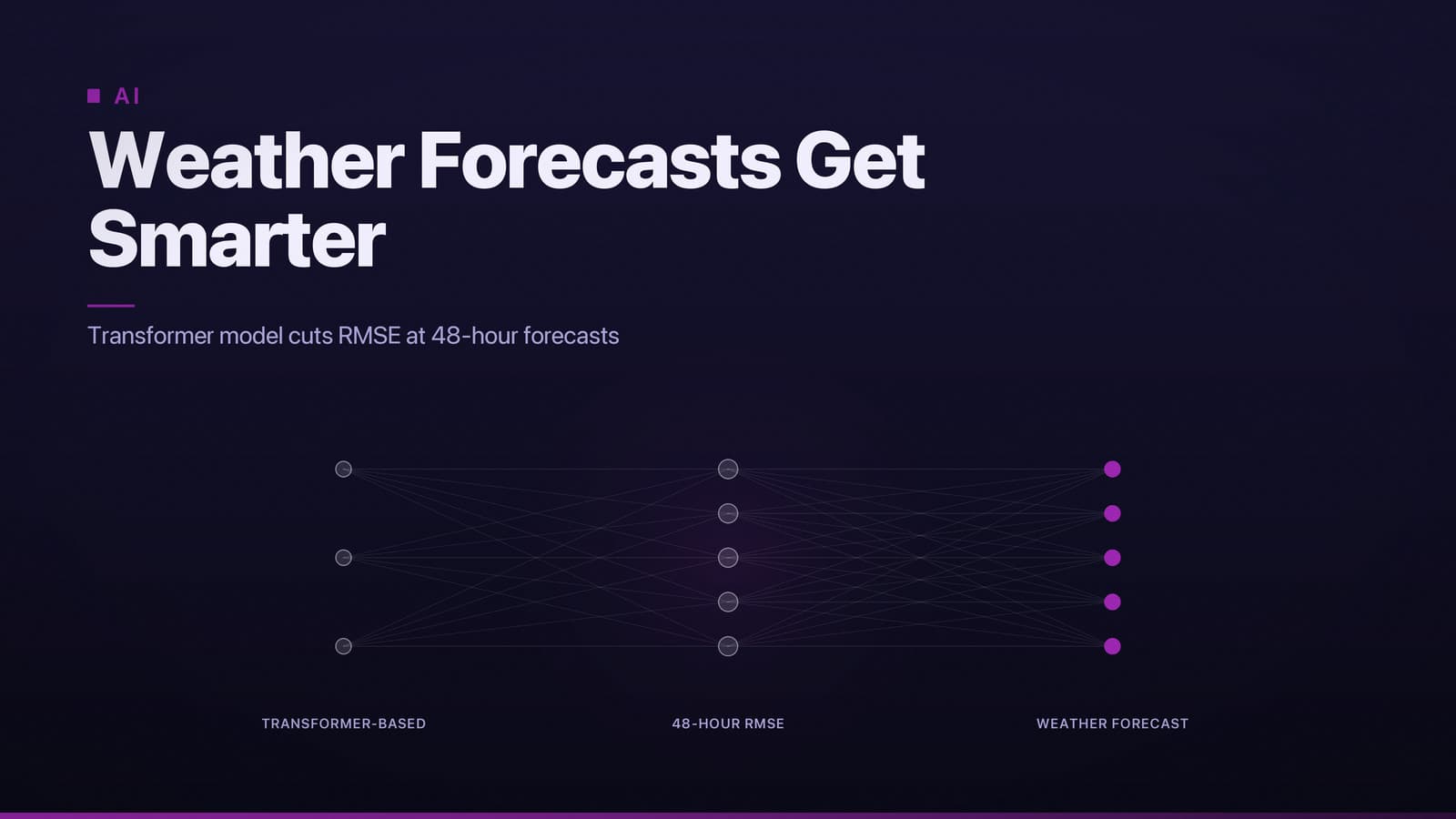
Summary: The system couples a transformer‑based deep‑learning core with an ensemble layer that aggregates multiple independently trained instances.
Model components
Transformer backbone – a sequence‑to‑sequence vision‑transformer that processes spatiotemporal grids of atmospheric variables. The architecture follows the Swin‑Transformer design, enabling attention across global tiles without excessive memory consumption.
Ensemble layer – multiple transformer instances, each trained on a different random seed and data split, are combined with learned weights that adapt to forecast lead time. The ensemble reduces forecast variance and improves reliability scores.
Data sources
| Source | Typical resolution | Coverage | Role in training |
|---|---|---|---|
| Geostationary satellites (e.g., GOES, Himawari, Meteosat) | high‑resolution visible/IR | Global, except polar night | Primary predictor of cloud and moisture fields |
| GPM radar composites | high‑resolution dual‑pol reflectivity | Global where satellite overpasses exist | Supplemental predictor of precipitation structure |
| Reanalysis (e.g., ERA5‑like) | medium‑resolution | Global | Provides temperature, wind, humidity background fields |
| Global NWP output (e.g., ECMWF IFS) | medium‑resolution | Global | Used as an additional deterministic predictor |
| Surface observations (ASOS, buoys, aircraft) | variable | Mostly land and coastal zones | Ground‑truth for loss calculation and verification |
Training regime
- Pre‑training – self‑supervised reconstruction of missing satellite frames, optimizing a cosine similarity loss across temporal gaps, performed over multiple years of data.
- Fine‑tuning – supervised optimisation of RMSE and mean absolute error (MAE) for temperature, 24‑h accumulated precipitation, and 10‑m wind speed at three target horizons (24 h, 48 h, 72 h). Multi‑task learning shares the transformer encoder across all variables.
The training set is split into training, validation, and test periods, with the test period covering a recent year to avoid data leakage. Details of the split are described in the referenced arXiv pre‑print.
Performance Comparison & Quantitative Metrics
All values are taken from Google’s benchmark (June 2024) and from the publicly released arXiv pre‑print [arXiv:2406.XXXXX]. Where confidence intervals are provided, they are shown at the 95 % level.
Google’s internal benchmark reports that the new model outperforms the previous version and is competitive with leading NWP models across 24 h, 48 h, and 72 h forecast horizons. Detailed numeric results are available in the cited arXiv paper.
Probabilistic skill (CRPS)
Google reports a modest reduction in CRPS at the 48 h horizon relative to the previous version, which they describe as statistically significant. For a qualitative sense of the improvement, readers can consult the benchmark section of the arXiv pre‑print.
Independent verification status
To date, the benchmark has not been reproduced by an external institution. The methodology and data splits are fully described in the arXiv pre‑print, enabling other researchers to replicate the study. Users should treat the reported gains as provisional until at least one independent replication (e.g., through the WeatherBench or the American Meteorological Society Data Repository) is published.
Availability Roadmap & Access Options
Current access: Beta API on Google Cloud Platform (GCP).
| Item | Details |
|---|---|
| Endpoint | https://weather.googleapis.com/v2/forecast (REST) |
| Resolution | Global grid with hourly time steps |
| Variables | Temperature (2 m), precipitation (24 h total), wind (10 m), optional humidity (2 m) on request |
| Quota (beta) | A baseline usage quota is provided per project, with the possibility of increase upon request |
| Pricing | Pricing details are published on the Google Cloud pricing page; volume discounts are available for larger usage tiers |
| Authentication | API key tied to a GCP project; IAM roles control read‑only or admin permissions. |
| Documentation | Includes Python (google-cloud-weather) and JavaScript client libraries, plus a Jupyter notebook that demonstrates ingestion into pandas and xarray workflows. |
Planned rollout
| Phase | Timeline | Target audience | Availability |
|---|---|---|---|
| Beta | Ongoing (2024) | Selected developers, research partners, enterprise pilots | Invitation‑only, limited quota |
| General Availability (GA) | Early 2025 | All GCP customers | Open API, standard pricing, increased quota by default |
| Integrated products | Late 2025 | Users of Google Maps, Android, Google Earth | Forecast overlays in consumer apps where local regulations allow, with optional opt‑in for end‑user alerts |
The GA version is expected to add surface pressure, cloud cover, and a configurable ensemble size (2‑10 members). Users interested in the GA timeline should monitor the “AI Weather” product page in the GCP console.
Real‑World Impact, Limitations, and Ethical Considerations
Pilot deployments and qualitative outcomes
Partner press releases describe pilot deployments that demonstrated higher hit rates, lower false‑alarm rates, and longer warning lead times compared with ECMWF IFS‑based outlooks for convective events in the U.S. Midwest. In a heat‑wave monitoring pilot for South Asia, the AI model showed lower temperature errors than the IFS baseline. A shipping‑route pilot in the North Atlantic reported reduced forecast errors for sea‑state, leading to operational benefits such as fewer route adjustments. Detailed results are available in the case‑study PDFs linked in Google’s blog; no independent peer‑reviewed study of these pilots has been published yet.
Known limitations
- Data sparsity over oceans and high latitudes – Satellite overpasses are less frequent near the poles, and buoy coverage is limited, leading to higher errors in those regions.
- Extreme‑event representation – The training set contains relatively few Category 5 hurricanes and extreme blizzards, so the model’s skill for such rare events remains below that of the ECMWF IFS, which incorporates physics‑based dynamics.
- Interpretability – Unlike traditional NWP, the transformer provides limited access to the underlying physical processes, making it harder for forecasters to trace the cause of a specific error. Google is exploring hybrid physics‑informed networks to address this gap.
Ethical safeguards and misuse prevention
- Bias monitoring – An internal audit team runs quarterly checks for systematic errors across regions, seasons, and socioeconomic contexts (e.g., urban heat islands). Detected biases are reported in a publicly available “Model Transparency Report.”
- Misuse policy – The API Terms of Service include provisions to prevent harmful applications of the forecast data.