Email Marketing vs. Newsletters: Which Fits Your Business?
Learn the practical differences between transactional email marketing and content newsletters, and how to choose the right strategy for your business goals.
The Functional Difference: Action vs. Engagement
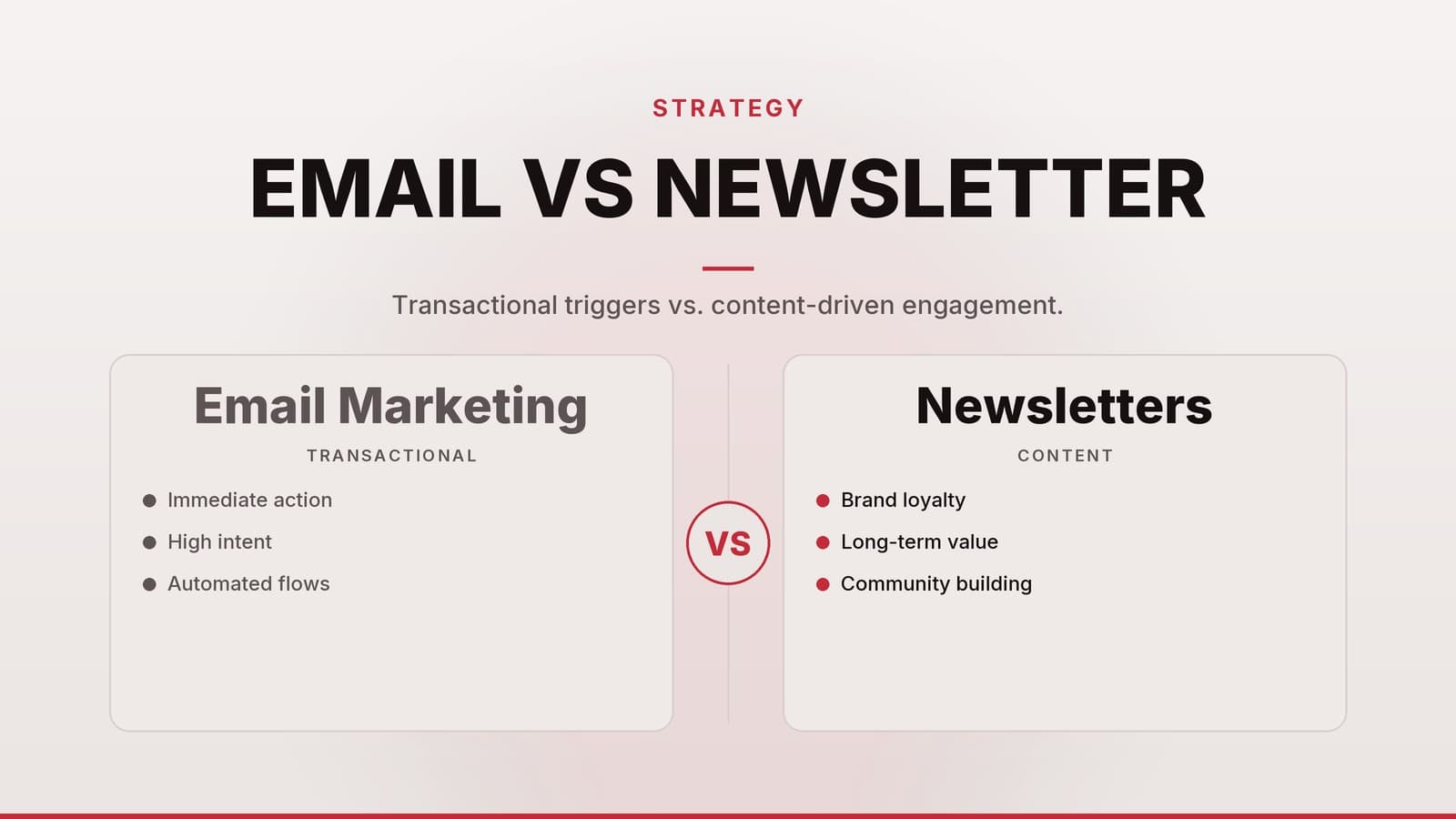
Many business owners use the terms "email marketing" and "newsletter" interchangeably, assuming they are just different names for the same mass message. While both involve sending emails to a group of people, their underlying purposes, structures, and how you measure their success are fundamentally different. Understanding this distinction is the first step in deciding which tool—or combination of tools—will actually help your bottom line.
Email marketing is primarily a sales and retention engine. Its goal is to drive a specific, immediate action. This could be making a purchase, booking an appointment, redeeming a coupon, or responding to a cart abandonment. The content is usually concise, focused on a single offer or message, and designed to convert the reader into a customer or a repeat customer. It is transactional.
Newsletters, on the other hand, are content and relationship tools. Their primary goal is to provide value, build authority, and keep your brand top-of-mind without necessarily asking for a sale in that specific email. They are editorial. A newsletter might share a story, an industry insight, a behind-the-scenes look, or a helpful guide. The return on investment here is longer-term: trust, loyalty, and brand recognition.
Consider a restaurant. Marketing emails are perfect for announcing a new menu launch, sending a "we miss you" offer to lapsed customers, or highlighting loyalty rewards. These emails are short, visual, and have a clear call-to-action (CTA) like "Book a Table." A newsletter from the same restaurant might tell the story of the chef’s journey, explain the local sourcing of their ingredients, or share a recipe that complements their dishes. This content builds an emotional connection with the community, making customers more likely to choose that restaurant over a competitor when they are hungry.
In short: if the email asks "Buy this" or "Book now," it is email marketing. If the email says "Here is something interesting to read," it is a newsletter. Most successful businesses use both, but they serve different functions in the customer journey.
Key Operational Differences
Beyond the high-level purpose, there are practical operational differences that affect how you create, send, and analyze these emails. Ignoring these differences can lead to confused customers and poor performance. Note that while this distinction is useful for planning, the boundary is not absolute. A "New Product Launch" newsletter is triggered by a business event, and a "Black Friday Sale" email is a broadcast. The key is whether the primary intent is to sell now or to build a relationship over time.
| Feature | Email Marketing (Sales/Action) | Newsletter (Content/Relationship) |
|---|---|---|
| Primary Goal | Conversion, Revenue, Retention | Engagement, Authority, Brand Awareness |
| Trigger | Often behavioral (cart abandonment, birthday) or event-based (sale, new arrival). | Typically follows a fixed editorial calendar (weekly, monthly, quarterly). |
| Content Structure | Focused, concise, and driven by a single primary Call-to-Action (CTA). Design directs attention to one button or link. | Multi-section, informative, and varied. Can contain multiple links, topics, and media types. Reader is expected to explore. |
| Audience Expectation | Relevance to recent interactions. If they just bought a shirt, they don’t want another shirt offer; they want a care guide or accessory. | Consistency in quality and voice. Subscribers are signing up for your expertise or perspective. If quality drops or it becomes too salesy, they unsubscribe. |
| Frequency | Can be high (daily in some e-commerce models) because it is tied to user behavior. | Lower (weekly to quarterly) because it requires significant time and thought to produce. |
| Measurement | Conversion Rate (CVR), Revenue per Email, Click-Through Rate (CTR) on specific CTA. | Open Rate, Click-Through Rate (on general content), Subscriber Growth, Unsubscribe Rate. |
If you judge a newsletter by immediate revenue, it will likely look like a failure. If you judge a marketing email by open rates alone, you might miss the fact that it generated significant sales. Use the right metric for the right job.
Choosing the Right Approach for Your Business Type
There is no one-size-fits-all answer, but certain business models lean more heavily on one approach than the other. Use the following matrix to identify where your business fits and where to start.
Decision Matrix
| Business Type | Primary Focus | Secondary Role | Why? |
|---|---|---|---|
| Service Businesses (Salons, Gyms, Clinics) | Email Marketing | Newsletter | The goal is to fill calendars and retain clients. Automated rebooking and win-back campaigns drive immediate revenue. |
| Retail & E-Commerce | Email Marketing | Newsletter | Promotions, inventory updates, and cart recovery are the "bread and butter" of online sales. Newsletters differentiate the brand from discount-only competitors. |
| B2B, Coaching & Consulting | Newsletter | Email Marketing | Sales cycles are longer, and trust is the currency. Demonstrating expertise through content is essential before a sale can happen. |
| Solo Entrepreneurs / Small Teams | Start with One | Add the other later | Limited resources mean you should focus on the approach that aligns with your immediate revenue goal to avoid burnout. |
How to Apply This
- For Service Businesses: Lead with marketing emails to drive bookings. Use the newsletter to nurture the relationship between visits. For example, a gym might send a "last minute" availability alert (marketing) and a monthly "Member Spotlight" (newsletter).
- For Retailers: Use marketing emails for the "push" (sales, discounts) and newsletters for the "pull" (brand values, product stories). This helps you stand out from competitors who only send discount codes.
- For B2B and Consultants: Lead with the newsletter to build authority. The sales emails will be more effective because the audience already trusts your expertise. Use marketing emails only for specific events, webinars, or service offers after trust has been established.
- For Small Businesses with Limited Resources: If you need cash flow now, focus on marketing emails (promotions, rebooking). If you are building your brand from scratch, focus on a simple newsletter to establish your voice. Do not try to do both perfectly at the start. Master one, then add the other once you have a system in place.
Practical Implementation Steps
Once you have decided on your primary focus, follow these steps to implement it effectively. These steps are designed to be practical for non-technical owners, focusing on setup, compliance, and sustainable growth.
1. Audit Your Current Email List
Before you send anything, clean up your list. A dirty list hurts your deliverability and wastes your time.
- Remove inactive subscribers: If someone hasn’t opened an email in 6–12 months, they are unlikely to convert. Sending to them can hurt your domain reputation.
- Segment your list: Group subscribers based on their interests or past purchases. For a retail store, this might be "Bought Shoes" vs. "Bought Apparel." For a service business, this might be "New Clients" vs. "Loyal Regulars."
- Ensure compliance: Make sure you have permission to email these people. Check that your sign-up process is clear and that you have a way for people to unsubscribe easily. Important: Email marketing regulations vary significantly by region (e.g., GDPR in Europe, CAN-SPAM in the US, CASL in Canada). Each has specific rules regarding consent, identification, and unsubscribe mechanisms. You should consult with a legal professional or a compliance expert to ensure your practices meet the requirements for your specific location and industry, especially if you handle sensitive data.
2. Define Clear Goals
Write down what you want to achieve with this specific campaign. Vague goals lead to vague results.
- Marketing Goal Example: "Increase appointment bookings by 10% next month."
- Newsletter Goal Example: "Grow our subscriber list by 5% and maintain a 20% open rate."
- Specific goals help you choose the right content and measure success accurately. Without a baseline, you cannot know if changes are working.
3. Select the Right Platform
Not all email tools are created equal. Your choice should depend on your primary focus.
- For Marketing Emails: Look for platforms with strong automation features (cart abandonment flows, birthday emails) and robust segmentation tools.
- For Newsletters: Look for platforms with rich text formatting options, easy-to-use drag-and-drop editors, and good analytics for content engagement.
- Check integrations: Ensure the tool connects with your CRM, e-commerce platform, or booking system. If your email tool doesn’t talk to your booking system, you will be manually updating lists, which is prone to error.
- Cost Consideration: Most tools in this space charge per user or per contact. Some charge based on the number of emails sent. Check the vendor’s current pricing page to see if a single plan covers your needs or if you need a more specialized tool. For small businesses, a mid-range plan that includes both basic automation and good design tools is often the most cost-effective starting point.
4. Start with a Pilot Campaign
Do not launch a massive campaign on day one. Start small to test your assumptions.
- Test subject lines: Send two variations to a small segment of your list to see which gets more opens. Note that with small lists, A/B testing may not yield statistically significant results, so treat these as directional indicators rather than definitive proof.
- Test send times: Try sending on Tuesday vs. Thursday, or morning vs. afternoon.
- Test content format: For newsletters, try a different layout or topic to see what resonates.
- Analyze results: Look at what worked and what didn’t. Use this data to refine your strategy before scaling up.
5. Monitor Deliverability
Even the best email will fail if it lands in the spam folder.
- Warm up your domain: If you are using a new email address for your campaigns, start by sending to a small group and gradually increase the volume.
- Monitor bounce rates: If your bounce rate is high, your list is dirty. Clean it up immediately.
- Check spam filters: Tools exist that can tell you if your email is likely to be marked as spam. Understanding how recipients’ clients handle incoming mail can give you insight into why some emails might be missed.
6. Iterate and Improve
Email marketing is not a set-it-and-forget-it task. Review your performance monthly.
- What subject lines worked best?
- Which CTAs had the highest click-through rates?
- Are your open rates declining? If so, your list may be becoming less engaged, or your content may need to be more relevant.
How HeyGrowin can help
HeyGrowin builds tailored digital solutions for small businesses, including CRM systems, booking platforms, and AI automation that can streamline your email marketing efforts. We can help you set up automated campaigns, clean and segment your customer data, and integrate your email tools with your existing booking or inventory systems to ensure a seamless customer experience. Visit heygrow.in to explore how we can support your growth.
Frequently asked questions
Can I use the same email list for both marketing and newsletters?
Yes, but it is best to segment your list. Some subscribers may prefer only promotional offers, while others may only want content. Sending the wrong type of email can lead to unsubscribes.
How often should I send a newsletter?
There is no one-size-fits-all answer. Weekly is common for news and content-heavy businesses, while monthly is often better for smaller businesses with less content to produce. Consistency is more important than frequency.
Do I need a separate tool for email marketing and newsletters?
No, most modern email marketing platforms can handle both. However, you may need to configure different templates and automation rules for each type of communication.